

Every luxury watch brand wants a motorsport story. Not all earn it. The difference between a real partnership and a marketing sticker is what they build and how long the two sides stay together. Some collaborations have lasted decades. Others were poached the moment a bigger check appeared.
Here's what's real, what changed hands, and why.
IWC and Mercedes-AMG: The Longest Marriage in the Business
Partners since 2004 and official engineering partner of the F1 team since 2013. That's over two decades, which in a business of five-year sponsorship deals is basically a lifetime commitment.
What makes it work is that the pairing isn't cosmetic. IWC calls itself "Engineered" as a brand identity, and Mercedes-AMG builds each engine by hand under the "One Man, One Engine" philosophy. Both companies sell precision as the whole point, not the paint job. The Pilot's Watch Chronograph line has carried the AMG name since 2021. IWC continues to produce dedicated team watches for the Mercedes-AMG Petronas squad, most recently the Pilot's Watch Mark XX in 2025. Ambassadors like Andrea Kimi Antonelli and George Russell reinforce it every race weekend. This is what a partnership looks like when neither side rents the other's logo.
TAG Heuer and Red Bull Racing: Since 2016, Built on Speed
TAG's whole identity is "Don't Crack Under Pressure," and Red Bull Racing has spent nearly two decades proving that motto on the track. The partnership started in 2016 and has deepened, with TAG briefly lending its name to Red Bull's engine program in 2016 and 2017 before Honda took over.
The watches lean into team livery: Red Bull's dark blue, red, and yellow appear throughout the Formula 1 collection, down to a checkered pattern nodding to the F1 starting grid. A 2025 limited edition of 3,000 pieces marked the team's 20th anniversary. This partnership sells motorsport energy at a price point most collectors can reach, which is why it's one of the more recognizable pairings in the category.
Richard Mille and Ferrari: The Latest Owner of a Contested Relationship
Most people don't know this. Ferrari has changed watch partners twice. Girard-Perregaux held the relationship first. Hublot took over in 2011 in a 9-year deal and produced the Big Bang Ferrari line and the wild MP-05 LaFerrari, a watch with 11 stacked barrelsmimicking an engine bay. Jean-Claude Biver, Hublot's chairman at the time, called it "an ambassador partnership," meaning Ferrari's name did more for Hublot than vice versa.
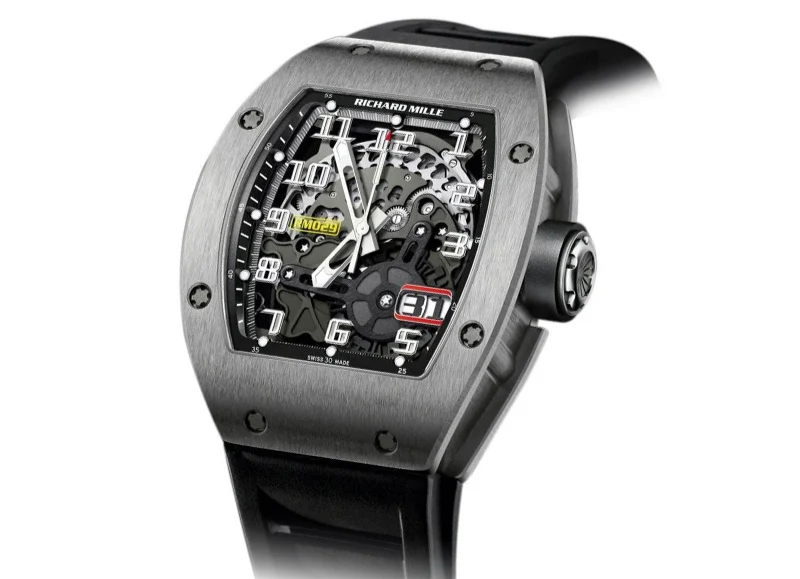
In 2021, Richard Mille won the account. The result was the RM UP-01 Ferrari, the thinnest mechanical watch ever made at 1.75mm, the product of over 6,000 hours of joint R&D. While Hublot's Ferrari watches favored dashboard styling and racing colorways, RM's approach went the other way: an engineering flex disguised as a watch, built with the same obsession over grams and tolerances as a Formula 1 chassis. It's fitting for a brand whose identity is that a watch should perform like machinery, not just look like it.
Besides the Ferrari F1 team, they also sponsor the McLaren F1 team, the current constructors' champions.

Whichever brand holds the Ferrari license at any given moment tells you something about who's winning the marketing war in luxury watches that year. Right now, that's Richard Mille.
Jacob & Co. and Bugatti: The Watch With an Engine Inside It
This one isn't a livery deal. Jacob & Co. built a miniature, functioning replica of the Bugatti Chiron's W16 engine into the movement. Sixteen tiny pistons, a solid steel crankshaft, and two working turbochargers are visible under a sapphire crystal and activate when you press the crown. It took nearly a year of dedicated development for the first piece.
Since the partnership began in 2019, it has expanded to include the Twin Turbo Furious, the Epic X Chrono, and the Chiron Tourbillon line, with editions ranging from six figures to the millions, some limited to as few as six pieces. This happens when a watchmaker decides literal is better than symbolic. No other pairing on this list attempts to physically replicate the car's engineering inside the case, which is why it stands out.
The Honorable Mentions
A few more worth knowing if you're building out a collection with a motorsport thread:
Chopard has been the Mille Miglia's official timekeeper and sponsor since 1988. It is the longest-running partnership between a family-owned watch manufacturer and a motorsport event. Every driver in the historic Italian rally gets a Chopard watch, and the Scheufele family has personally raced since day one.
Breitling and Bentley had a 2002 to 2021 run that included a genuine dashboard tourbillon clock for the Bentayga, not just wrist pieces. Breitling has since moved on to Aston Martin, picking up where the Bentley relationship left off.
*Aston Martin also used to be partnered with Girard Perregaux.
Why This Keeps Happening
Cars and watches tell the same story: high-precision design you can wear or drive. A carmaker gets a wrist-sized signal of its brand in front of a wealthy audience every day. A watchmaker borrows horsepower, speed, and motorsport prestige that it could never manufacture on its own. When the partnership is real, like IWC and Mercedes-AMG or Jacob & Co. and Bugatti, both brands sell engineering obsession, and the watch reflects it.
It's Not New, Either
This is not a 21st-century marketing invention. Cartier put its name on the instrument panel clock of the Lincoln Mark III in 1969, and it stayed for decades across the Mark IV, the Town Car, and the Designer Series Lincolns of the '70s and '80s. Bill Blass, Emilio Pucci, Givenchy, and Cartier all had their own trim packages, and the Designer Series accounted for more than a quarter of Mark IV sales at its peak. Long before Richard Mille chased Formula 1 relevance, luxury brands understood that a name in the right car sells both the car and the name.
Collecting Advice: Which of These Holds or Increases Value Best?
Not every partnership piece appreciates, and the ones that do usually share the same traits: real production scarcity, a documented technical first, or a tie to a specific athlete or moment.
Richard Mille sits at the top of this list by a wide margin. RM produces roughly 5,000 to 5,600 watches a year across the entire brand, and that discipline shows up in resale. Athlete-linked references like the RM 035 Nadal, the RM 055 Bubba Watson, and the RM 011 Felipe Massa have traded well above original retail for years. The RM UP-01 Ferrari, limited to 150 pieces and the thinnest mechanical watch ever made, has changed hands privately for well over its original price. The pattern holds across the brand: current-production sport references with a strong story hold or gain, while discontinued mid-range models without a real narrative have softened the most.
Jacob & Co.'s Bugatti pieces are a different kind of collectible. Production is tiny by design, with some editions as few as six pieces, so the market for them is thin and mostly private. That works in a collector's favor if you already own one and want to sell, but it also means slower, harder-to-predict resale since so few examples ever trade publicly.

Chopard's Mille Miglia collection and Breitling's Bentley pieces sit in a calmer category. They're well-made and hold value reasonably, but they trade more like normal luxury watches than grail pieces, since production has been steady rather than scarce. IWC's Mercedes-AMG team watches fall into the same bucket. Strong brand, strong story, but not the kind of artificial scarcity that pushes prices past retail the way Richard Mille's allocation model does.
The short version: if appreciation is the goal, look for low production numbers, a documented first, or a name tied to the piece. If you just want a great watch with a real motorsport pedigree, most of these brands deliver that without the premium.
Market Availability: How Hard Is It to Actually Get One?
That same scarcity is exactly what makes some of these pieces hard to buy in the first place, and the difficulty varies enormously by brand.
Richard Mille is the hardest to buy new. Most current models carry multi-year waitlists through authorized boutiques, and allocation depends as much on relationships and purchase history as on available funds. For collectors, that means the realistic path in is almost always the secondary market rather than the boutique, and even there supply stays thin because owners tend to hold rather than flip.
Jacob & Co.'s Bugatti watches follow a similar pattern but through a different door. The brand sells largely through direct allocation to established clients rather than open retail, so a piece rarely shows up on the open market at all. When one does surface, it's usually a private sale rather than a public listing.
TAG Heuer's Red Bull Racing pieces and IWC's Mercedes-AMG watches are the most accessible on this list. Current references can generally be bought new through authorized dealers without a years-long wait, though the true limited editions, like TAG's 3,000-piece 20th anniversary release, do sell out and then carry a modest premium once gone.
Hublot's original Ferrari partnership pieces now sit in a category of their own. Production ended when the Ferrari deal closed in 2020, so every Big Bang Ferrari and MP-05 LaFerrari on the market today is pre-owned, and availability depends entirely on what collectors are willing to part with.
Authenticity: How to Verify These Pieces
Motorsport-branded watches are aggressively counterfeited because the branding is so recognizable and the price premiums are so high. A few things matter more here than with a standard watch.
Documentation is the first line of defense. Limited editions are individually numbered, and that number should match the warranty card, the certificate of authenticity, and often an engraving on the case back. For Jacob & Co.'s Bugatti pieces and Richard Mille's rarest references, that paperwork isn't optional; it's a meaningful part of what you're paying for, since a piece without full documentation can be difficult to resell at full value later.
Movement inspection matters even more on these watches than on a standard chronograph, since the whole point of pieces like the Jacob & Co. Bugatti or the RM UP-01 is the engineering inside. A qualified watchmaker can verify caliber details, finishing, and construction against published specifications, and this is worth doing before any high-value purchase, not after.
Buy from a dealer who authenticates in-house rather than taking a listing at face value. We inspect every watch that comes through Gotham Trading before it's offered, checking case construction, movement, and documentation against known references for that exact model. That matters even more with collaboration pieces, since a convincing fake of a Ferrari-branded Hublot or an RM UP-01 can fool a buyer who's only checking the dial.
If you're buying privately or on a marketplace, ask for a full box and papers, request close-up photos of the movement and case back, and confirm the reference and serial number independently before you pay. When in doubt, have a professional authenticate it before the transaction closes, not after.
Future Trends: What's Coming Next
The Aston Martin-Breitling partnership announced in February 2026 is the one to watch right now. It's a multi-year deal covering both the road cars and the Aston Martin Aramco Formula One team, and the first watch, the Navitimer B01 Chronograph 43 Aston Martin Formula One Team, has already launched, with more expected through the rest of the year. It's notable partly because Breitling previously held this same role with Bentley for nearly two decades, so there's a track record here worth following.
Roger Dubuis has also been quietly building out automotive ties, moving from a long run with Blancpain into partnerships with Lamborghini's Squadra Corse racing division and, before that, Italdesign's Zerouno supercar. Watch for that relationship to keep expanding, especially around Lamborghini's racing calendar.
On the Formula 1 side, keep an eye on how driver-level deals interact with team-level ones. Fernando Alonso, for example, is personally a Richard Mille ambassador even as his Aston Martin team now partners with Breitling, showing how these individual athlete relationships can run independently of the corporate sponsorship around them. Expect more of that layering as F1's popularity keeps pulling watch brands deeper into the sport.
If you're a collector building around this theme, the smart move is to watch which teams and manufacturers are in the running for watch partnerships. Ferrari has changed hands twice already. Aston Martin just did. When a marquee name is up for grabs, whoever wins it tends to produce the pieces collectors talk about years later.
If you're chasing a piece tied to one of these collaborations, whether it's a vintage Cartier or a current-production Richard Mille Ferrari, book an appointment, and we'll help you track down the real thing.